Logo-Free Isn’t the Same as Characterful: A Hong Kong Craft Case Study
The sameness problem nobody wants to name
Quiet luxury was supposed to be the grown-up answer to logomania: better fabrics, cleaner lines, no shouting. In 2026, though, it has become its own uniform. Walk through a well-edited American office, a nice hotel lobby, or a Sunday farmers market in a wealthy suburb, and you can play a predictable game: anonymous beige tote, anonymous gray sweater, anonymous low-profile sneaker. Everything is tasteful. Very little is memorable.
That is not a knock on good materials or restrained design. It is a knock on interchangeability. When every brand strips away logos and converges on the same camel, the same soft calfskin, the same not-quite-a-tote shape, the result is not quiet luxury. It is quiet sameness. You paid for quality, but you also paid to look like everyone else who paid for quality.
Hong Kong’s small-batch accessories scene offers a useful counterargument. The best work coming out of Hong Kong studios is not loud. It does not rely on a giant logo or a seasonal It-bag campaign. But it is recognizable. You can see the hand of a maker in the stitch, the edge, the hardware, the slightly irregular grain of a small-run hide. That is a different kind of quiet—one that reads as character rather than consensus.
What real handwork looks like up close
You do not need to be a leatherworker to tell the difference between craft and costume. You just need to touch the right details.
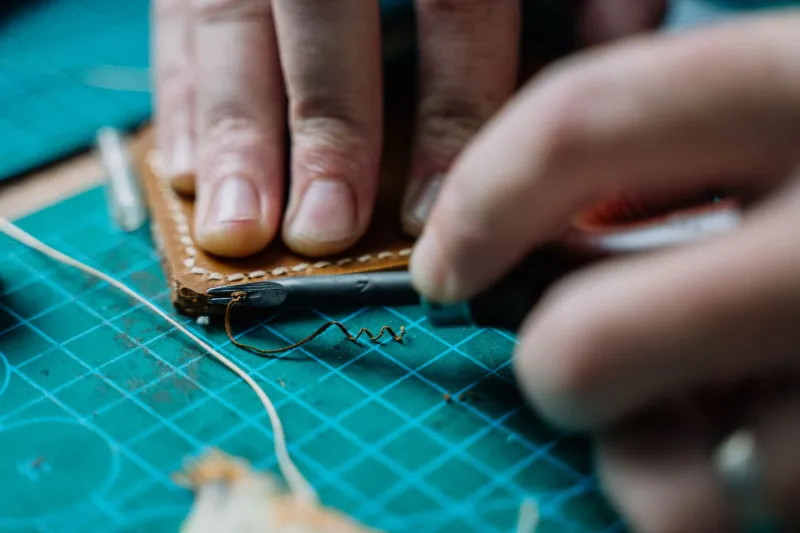
Stitching has rhythm, not perfection. Hand saddle stitching often shows tiny variations in stitch length and angle. That is not sloppiness; it is evidence of a human hand pulling waxed thread through two needles. What you want to avoid is wobbly machine stitching, skipped stitches, or loose thread ends hidden under a lining. Turn the piece over. Real handwork usually looks as tidy on the backside as it does on the front.
Hardware should feel like hardware. Solid brass has weight and a slightly warm tone. Plated zinc alloy can look fine in photos and feel hollow in hand. Look at the edges of buckles and D-rings, the screw heads on strap anchors, and the pull on a zipper. A maker who cares about hardware will use pieces that are finished on the underside, not just the side that faces the camera.
Small-run materials are not supposed to match perfectly. Deadstock canvas, limited tannery lots, and vegetable-tanned leather all vary. One panel may be slightly darker than another. The grain may shift across a bag. That is different from a fast-fashion print that repeats every six inches. Variation is a signature, not a defect—as long as the construction is consistent.
Three Hong Kong makers that fit a US wardrobe
Nga Studio: the commuter tote
Nga Studio makes a quietly excellent everyday tote in vegetable-tanned leather, with hand-burnished edges and solid brass feet. The shape is clean enough for a US office but not so precious that you panic when it rains. The strap attachments are stitched and riveted, not just glued, which matters once you start carrying a laptop, a water bottle, and the inevitable extra layer. This is the bag that replaces three mediocre totes—and looks better doing it.
Tse Object: the evening frame bag
Tse Object’s small frame clutches are the kind of piece that makes a simple outfit feel considered. Silk lining, a hand-set clasp, and a chain that is actually finished at the ends. No logo. No seasonal gimmick. It works with a wedding guest dress in the Hamptons and a plain black outfit in New York. The point is not that it is fancy. The point is that it is specific: you can feel the difference between a bag made to be photographed and a bag made to be carried.
Kwan Workshop: the weekend crossbody
Kwan Workshop pairs waxed canvas with leather trim on a compact crossbody that is light empty and easy to adjust. The lining is water-resistant, the strap is wide enough to distribute weight, and the closure is a quiet magnetic flap rather than a fussy buckle. It is the bag for a Saturday market run, a museum afternoon, or a weekend trip where you do not want to think about your bag. Small-run materials mean the canvas color can shift slightly from batch to batch—which is exactly the point.
How to buy without getting fooled
Ask questions. A good maker will not be offended. What tannery is the leather from? Is the hardware solid brass or plated? Is the bag hand-stitched or machine-stitched, and where? What is the repair policy? Can you see a photo of the actual unit you are buying, not just the sample?
Quiet craft is not quiet because it is beige. It is quiet because the details do the talking. That is a better standard than logo-free. It is character-full.
The takeaway
If you are rebuilding a modern wardrobe in 2026, do not stop at removing logos. Look for the evidence of a human hand: the stitch that is not identical to its neighbor, the hardware that has weight, the material that varies because it came from a small run. Hong Kong’s small-batch makers are not trying to out-luxury the luxury houses. They are offering something more useful—accessories you can recognize without a logo, and keep without regret.