The Sidewalk Syllabus: What Sham Shui Po Teaches Before You Buy a Hong Kong Bag
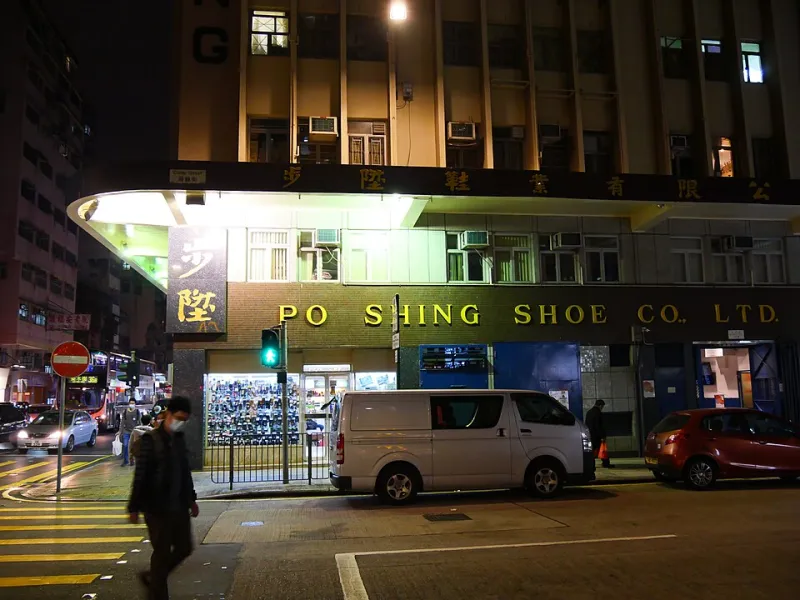
Photo: Peachyeung316, CC BY-SA 4.0, via Wikimedia Commons
You can learn a lot about a Hong Kong wallet without touching it. Start by walking the neighborhood where its parts were chosen.
Sham Shui Po is not a showroom. It is a material district: a few dozen blocks in Kowloon where fabric, leather, zippers, thread, labels, and the machines that join them all sit within a short walk of one another. For a U.S. shopper, the district is armchair travel with a practical payoff. Every stop explains a decision you can read in the finished bag — and a line item you are paying for.
Here is a walking tour, block by block, of the places behind the accessories that reach American closets.
Ki Lung Street: The Color Library With a Cash Register
Begin at the trim stalls. Ki Lung Street is where ribbons, webbing, buckles, D-rings, swivel hooks, and spools of thread are stacked in plastic bins and hung from ceiling hooks. It looks like a craft store exploded. It behaves like a stock market.
A trim stall is a color library with a cash register. The difference between a bag that feels considered and one that feels assembled often comes down to whether the maker bought the right shade of black webbing, the right matte finish on a ring, or the right thread weight for a leather seam. Buying those details in small quantities is more expensive per unit. A maker who orders 50 pieces instead of 5,000 pays more, waits longer, and usually does it anyway because a mismatched dark brown is impossible to unsee.
What this teaches a shopper: hardware is not decoration. Run your thumb over a ring. Look for a finish that does not flake at the edge, a spring gate that returns cleanly, a D-ring that sits flat against the bag instead of twisting. Those are small material decisions made in a district like this one, and they show up in the price.
Tai Nan Street: Leather Is Sold by the Side, Not the Season
A few blocks over, the leather merchants work in a quieter key. Hides hang or lean in rolls, and the air smells like tannery and dust. In fashion marketing, leather is a season. In Sham Shui Po, it is a side of hide with a shape, a temper, and a list of flaws.
A maker walks in with a pattern and a cut plan. The merchant pulls a side. They check stretch, scars, and grain. A small workshop cannot afford to waste half a hide, so it cuts around the marks. That is one reason a small-batch Hong Kong bag can cost more than a mass-market one with similar dimensions: the maker is paying for the leather that gets thrown away, not just the leather that gets sewn.
This is also where dye lots become real. Two blacks can be two different blacks, especially across separate dye runs. A careful maker keeps a cutting record and avoids mixing lots on the same panel. If you are buying from the U.S., ask whether the front and back panels came from the same lot. A maker who knows will answer without hesitation.
What to read in the finished piece: edges that are painted or burnished rather than raw and cracking, lining that does not pucker, and a grain that looks like skin rather than plastic. None of that guarantees quality, but together they suggest someone was paying attention at the cutting table.
The Notions Counter: Zippers Are a Small Essay on Restraint
Zippers deserve their own stop. In Sham Shui Po, they are sold as components: tape, teeth, slider, puller, end stops. A zipper specialist can tell you why a stiff tape ruins a soft bag, why a metal tooth is not automatically better than a molded one, and why the puller should feel like it belongs to the hand that will use it.
A zipper is three parts and a decision. The tape needs to flex with the bag. The slider needs to move without catching. The puller needs to be easy to grab but not so long that it snags on a sleeve. On a small accessory, the zipper is often the first thing to fail and the hardest thing to replace. That is why repair-first makers spend disproportionate time here.
At the counter, you see the cost of restraint. A maker can buy a cheap zipper by the gross or a better one by the dozen. The better one may cost three times as much. On a $200 wallet, that difference is small in dollars and large in feel. Check the zipper tape for fraying, run the slider along the full length, and look at how the seam sits next to the teeth. A straight stitch line around a zipper is a quiet flex.
Upstairs: The Workshop Is the Quiet Part
The best stop is not on the sidewalk. Walk into one of the older industrial buildings, take the freight elevator or the narrow stairs, and you find small workshops with cutting tables, skiving machines, and sewing machines that have been serviced more often than replaced.
This is where the district’s material culture turns into design. A small workshop does not run a long assembly line. The same hands may cut, skive, glue, stitch, and finish. That means fewer units per day and more consistency per piece — or at least more accountability. It also means lead times are real. A maker cannot promise a bag next week if the leather has not arrived and the zipper puller is on backorder.
What to read in the finished piece: seam allowances that are trimmed evenly, edges that are finished on both sides, and hardware that is backed with reinforcement inside the lining. Those are not visible in a product photo. Ask for interior shots. Ask what happens if a stitch fails. A workshop that repairs its own work will usually tell you exactly how.
The Paper Trail: Labels, Hangtags, and the Last Ten Percent
Finish the walk near Yu Chau Street, where small print shops and packaging suppliers sit among the bead and trim stalls. This is the last ten percent of the accessory: the hangtag, the dust bag, the care card, the little box that survives a 3,000-mile trip.
Packaging is not proof of quality. It is an introduction. But it does reveal whether a maker thinks about the whole object or stops at the seam. A care card that names the leather and the lining is more useful than one that says ‘luxury.’ A dust bag that fits the product is better than one that is obviously generic. These are small signals, and they matter when you are buying sight unseen.
If You Are Reading This From the U.S.
You do not need a plane ticket to use the syllabus. You need better questions. Ask where the leather was cut, whether the hardware is solid brass or plated, what zipper brand the maker uses, and how long a repair would take. Ask for a photo of the interior. Ask whether the maker buys in small lots. The answers will tell you whether the price reflects materials and labor or just the word ‘artisan.’
Sham Shui Po is not a secret. It is a working district, and like any working district, it rewards attention. The next time you look at a Hong Kong bag or wallet, picture the trim stall, the leather side, the zipper counter, and the upstairs table. The piece in your hand is the last stop on a walk you can now read.