The Case for Fewer Layers: What Hong Kong’s Unlined Wallets Get Right
Most wallets are built like tiny suitcases. There’s an outer shell, an inner lining, a stiffener, maybe a plastic card frame, and enough seams to make a small map. That engineering can feel reassuring on a shelf. In the hand, though, it often turns into bulk—and bulk is the enemy of a wallet you actually want to carry.
Hong Kong’s small leather workshops tend to go the other way. Ask a maker about an unlined wallet and you’ll hear a version of the same idea: fewer layers, better years. Not because minimalism is trendy, but because leather behaves best when it has room to move, darken, and soften. The structure should come from the pattern and the fold, not from a hidden sandwich of materials.
Why less structure often ages better
An unlined wallet is exactly what it sounds like: no fabric lining glued or stitched inside. The leather you see is the leather you touch. That matters for two reasons. First, there’s less to delaminate, bubble, or wear through. Linings can be lovely, but in thin goods they add thickness and create a second failure point. Second, the leather can patina evenly. When a card case has a lining, the outer shell and the inner layer can age at different rates, and the edges may start to look puffy before the leather itself is worn in.
Hong Kong makers often pair unlined bodies with skived edges. Skiving is the craft of thinning leather at the edges so it can fold cleanly or sit flush. A good skive is almost invisible: the edge tapers, the wallet stays slim, and the stitching has a consistent amount of material to bite into. A bad skive is either too thick—making the edge lumpy—or too thin—leaving the seam weak. This is one of those details that separates a workshop wallet from a mass-market one.
Single-piece folds are the other quiet hero. Instead of cutting three panels and joining them with seams, a maker may cut one piece and fold it into a card pocket or bill compartment. Fewer seams mean fewer places for dirt and moisture to collect, and fewer chances for the edge paint to crack. It also gives the wallet a softer, more organic shape over time. Think of it like a good pair of jeans: the fades come from the fabric bending where it needs to, not from artificial distressing.
The maker’s checklist: stitching and leather temper
You don’t need a workshop to judge a wallet, but you do need to look closely. Here’s a short checklist that Hong Kong leatherworkers tend to respect.
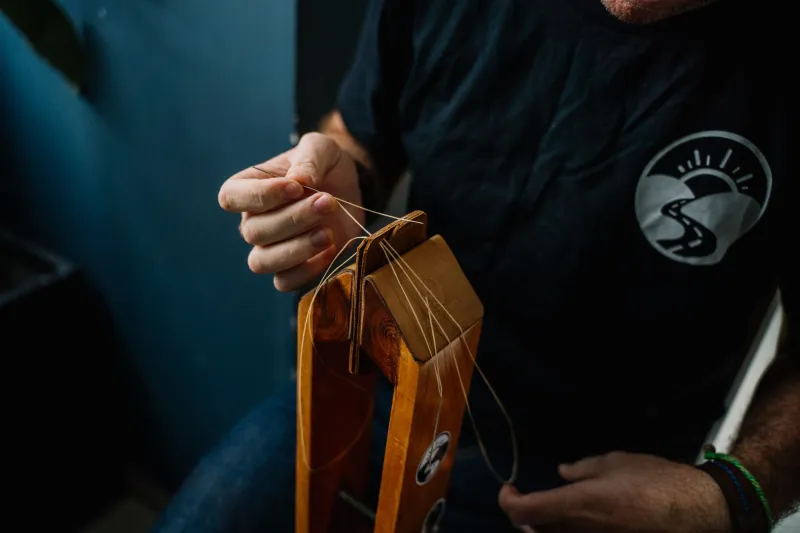
- Stitch density and tension. Look for even stitches with a slight slant, often called a saddle-stitch look. The thread should sit in the leather, not float above it. If you see skipped stitches, fuzzy thread, or a machine seam that pulls the edge into waves, keep walking.
- Edge finishing. A well-finished edge should feel smooth, not sharp or tacky. If it’s painted, the paint should be thin and even, with no globs at the corners. If it’s burnished, it should look polished rather than raw.
- Leather temper. Temper is the hand-feel and stiffness of the hide. A card case needs enough firmness to hold its shape but enough softness to flex when you sit down. Press the leather gently. If it feels like cardboard, it may crack at the fold. If it feels like a dishrag, it may stretch out.
- Fold behavior. Open and close the wallet a few times. The fold should move as a unit, without a hard ridge or a hollow pocket of air. On a single-piece fold, the curve should look continuous.
- Seam allowance. Peek inside. If the seam allowance is wide and bulky, the wallet will feel thicker than it needs to. A tidy, trimmed allowance is a sign the maker thought about the inside, not just the outside.
A US shopper’s comparison: slim card case vs. department-store wallet
If you’re shopping from the US, the easiest comparison is a slim Hong Kong-made card case against a mainstream department-store wallet. The department-store version often wins on features: more card slots, a clear ID window, a bill compartment, maybe a coin pocket. The Hong Kong card case may hold fewer cards and skip the extras. That’s the point.
Put them side by side and check the silhouette. A well-made unlined card case should sit flat when empty and stay reasonably flat when loaded. A bulky wallet may start thick and get thicker. Check the corners: on a cheap wallet, the corners are often folded over a stiffener and stitched shut, creating a hard nugget. On a better small good, the corner may be skived and folded with less bulk.
Then think about replacement cost. A department-store wallet might be inexpensive enough to replace every year or two. A workshop card case usually costs more up front, but the leather can darken and soften instead of falling apart. If you like the idea of a wallet that looks better in year three than year one, the unlined approach makes sense.
One caveat: unlined doesn’t automatically mean better. Some leathers are too soft for an unlined card case and will stretch. Some makers skimp on edge finishing because there’s no lining to hide behind. Ask about the leather, the skiving, and the thread. A good maker will happily explain. A vague answer is useful information too.
What to look for on Artisan Room HK
When you browse small leather goods from Hong Kong workshops, read the description like a maker’s note. Look for phrases like skived edges, single-piece fold, unlined body, and hand-burnished. Those aren’t buzzwords; they’re clues about how the object will wear. Then compare the measurements to your current wallet. If the card case is within a centimeter of what you already carry, you’re in the right zone.
The unlined wallet isn’t for everyone. If you need a dozen cards, cash, coins, and a receipt pocket, a more structured wallet may serve you better. But if you want a small good that earns its patina, fewer layers is often the smarter luxury. In Hong Kong, that’s not a trend. It’s just good leatherwork.