Three Days, One Bag: Five Hong Kong Workshop Pieces That Earn Their Space
A 72-hour trip is the hardest packing problem there is. Four days and you stop caring. Two days and you can fake it with a backpack. Three days means you need a real change of clothes, a laptop, chargers, toiletries, and something to carry on the day you're not wearing the bag.
The usual solution is to buy disposable gear at the airport — a nylon pouch that splits in a year, a tote that folds to the size of a paperback and feels like one. Hong Kong's small workshops make the opposite bet: fewer pieces, built heavier than they need to be, designed to pack flat.
Here are five that pull their weight. All fit inside a standard US carrier personal item (roughly 18 x 14 x 8 inches), and none of them is the bag you check.
1. The Slim Cable Pouch
What it is: A flat zip pouch, usually waxed canvas or vegetable-tanned leather, roughly the footprint of a paperback and about an inch thick when loaded.
Why it earns space: Chargers and cables are the great tanglers of modern travel. A dedicated pouch with a wide zip that opens the full length of the bag lets you see everything at once, which matters at 6 a.m. in a hotel room. Look for a boxed bottom seam so it stands open on the desk rather than collapsing.
Details to check: YKK or equivalent metal zip, bar-tacked stress points, and a lining that isn't glued in — glued linings delaminate in a checked bag's temperature swing.
2. The Fold-Flat Tote
What it is: A lightweight tote in ripstop nylon or heavy cotton canvas that folds into its own pocket, ending up around the size of a deck of cards.
Why it earns space: This is your second bag. It becomes the grocery run, the beach, the overflow when you bought one thing too many. A tote that packs to almost nothing costs you nothing to bring and saves you from buying a plastic bag you'll throw away.
Details to check: Straps should be stitched and then reinforced at the handle join — the single most common failure point on cheap totes. A flat bottom panel keeps it from becoming a sack.
3. The Travel Document Sleeve
What it is: A slim leather or canvas folder for a passport, boarding passes, and two cards. No more.
Why it earns space: It prevents the one genuinely bad scenario — digging through a full bag at a gate with a passport in your teeth. Keeping documents in one flat sleeve means you can pull it out blind.
Details to check: Skip anything with a thick laminated cover or heavy hardware; you want this to lie flat against your laptop sleeve. Vegetable-tanned leather adds almost no bulk and takes on a travel patina fast.
4. The Compact Dopp Kit
What it is: A toiletry bag in the 7 x 4 x 3 inch range, with a water-resistant lining and a flat base.
Why it earns space: US carriers still enforce the 3-1-1 rule for liquids in carry-on, so there's no point bringing a gym-bag-sized kit. A small bag forces discipline and sits upright on a hotel sink.
Details to check: A wipe-clean interior, a hang loop, and internal pockets that hold a razor upright. If the lining is stitched rather than heat-sealed, check that the seams are taped — a leaky shampoo bottle will find the one weak point.
5. The Packable Sling
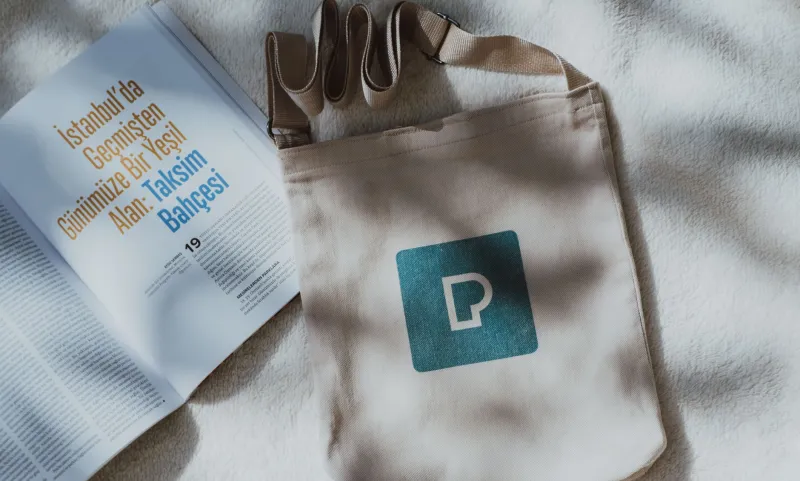
What it is: A small crossbody, often in waxed canvas, that folds down to roughly the size of a rolled pair of socks and clips flat against the inside of your carry-on.
Why it earns space: Day two is usually the day you walk. A sling holds phone, wallet, and keys without heating up your back the way a full backpack does, and it disappears into the main bag on travel days. Look for a body-facing zip, which makes pickpocketing meaningfully harder in crowded transit.
Details to check: Strap adjusters that don't slip under load, and a buckle that's plastic rather than metal if you're going through security often.
What We Left Out, and Why
Three things didn't make the cut. Packing cubes are useful but commoditized — a $15 set works fine and there's no artisan advantage. Leather luggage tags are lovely and get destroyed in baggage handling. And a second pair of shoes is a packing decision, not a purchase.
The through-line is simple: every item here is one layer of organization, not a gadget. None needs charging. None has a proprietary accessory. If one breaks in year three, a workshop can restitch it, and a good one probably will.
The Packing Math
The five pieces above weigh about 1.5 pounds combined and pack down into roughly the volume of a folded sweater. That leaves your personal item for three days of clothes — two shirts, one pair of pants, one spare layer, socks and underwear — with room for a paperback. No checked bag, no airport shopping, no gear that dies after five trips.
Small-batch construction isn't about luxury here. It's about buying the pouch once, on a Tuesday, and never thinking about it again at a gate in 2031.