What Your $225 Card Holder Pays For, Line by Line

Photo by Photo by Lifetime Leather on Unsplash on Unsplash
A handmade Hong Kong card holder can look expensive next to a $29 mall version. Then you see the receipt behind it. Not every high price is noble, and not every 'handmade' label is honest. But after talking to two Hong Kong makers about how a small-batch accessory actually gets priced, the numbers stop looking like mystery and start looking like math—lumpy, human, and sometimes uncomfortably tight.
The $225 card holder, opened up
Take a six-pocket card holder in vegetable-tanned calfskin, hand-burnished edges, made in a batch of 30 in a Sham Shui Po workshop. It sells direct to a US customer for $225. Here is a realistic per-unit cost sheet, based on figures from a leather goods maker we'll call Maker A and cross-checked with a Kwun Tong bag workshop we'll call Maker B.
| Line item | Per-unit cost |
|---|---|
| Vegetable-tanned calfskin, 0.8 sq ft with yield loss | $14 |
| Lining and reinforcement | $3 |
| Thread, edge paint, adhesive | $2 |
| Hardware: snaps, D-ring, rivets | $4 |
| Pattern and design amortization | $6 |
| Maker labor: 5 workshop hours at $20/hour | $100 |
| Sample, QC, and rework reserve | $8 |
| Packaging: box, dust bag, card | $7 |
| Outbound freight to the US, per unit | $10 |
| Payment processing and platform fees | $7 |
| US duty and brokerage reserve | $12 |
| Workshop overhead allocation | $12 |
| Total direct cost | $185 |
That leaves $40 per unit before the maker pays for marketing, returns, accounting, website hosting, and the occasional remake. Maker A laughed when we called that profit. 'It is not profit,' she said. 'It is oxygen.'
Why the numbers are lumpier than they look
A clean table hides the mess. Maker A buys leather by the hide, not by the card holder. One hide might yield 22 clean pieces if she cuts carefully, 18 if there is a scar or a soft spot. The leftover is not free; it is already in the price. Hardware often comes in minimum order quantities, so a small batch may sit on 200 snaps to get the right finish. Thread and edge paint are small costs until you factor in six colors and a shelf life.
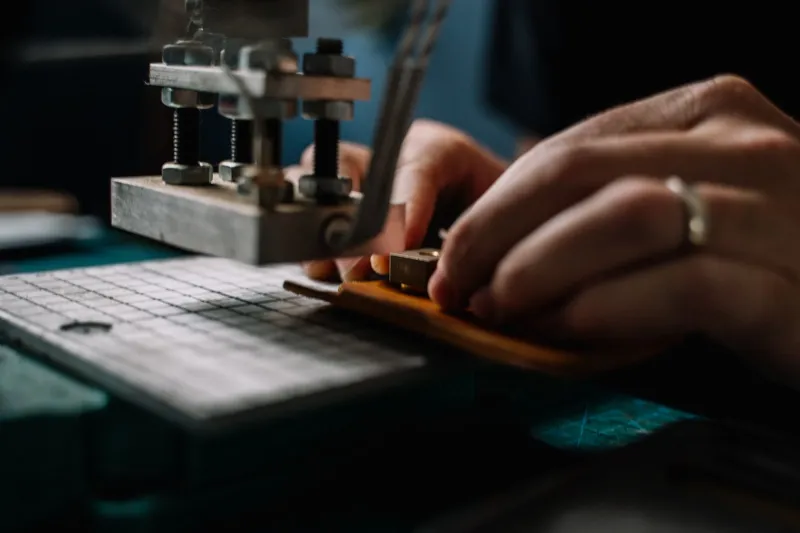
Labor is the biggest line, and the least compressible. Maker A quoted 4.5 to 6 hours per card holder depending on the leather and the stitch count. Maker B, who works mostly in canvas and leather bags, said a small tote can run 9 to 14 workshop hours. 'People see the finished object and think the time is the same as the video,' she said. 'The video is 30 seconds. The drying time is not.'
Freight is the wild card. A direct-to-US parcel might cost $8 one week and $13 the next. Packaging gets heavier when you add a box that survives international shipping. And in 2026, US shoppers should not assume small parcels sail through duty-free. Duties, brokerage, and carrier handling fees can apply, and who pays them depends on the seller's terms. A $225 card holder may land closer to $260 after shipping and import charges. That is not a trick; that is import math.
What fair pricing looks like from the outside
You do not need a maker's spreadsheet to spot a fair price. You need four answers.
First: how many workshop hours? A real number, not 'handcrafted with love.' Second: what leather, and from where? 'Genuine leather' is not an answer; it is a shrug. Third: what hardware and lining? Good makers know their zippers, snaps, and reinforcements because they have to repair them. Fourth: what is the repair policy? A maker who expects the piece to last will tell you how to fix it.
If those answers are vague, the price may still be fair—but you cannot tell. If the answers are specific and the math is tight, you are probably looking at a small-batch object priced for survival, not extraction. Maker B put it simply: 'We are not charging for the word handmade. We are charging for the hours that do not show up in the photo.'
This is also where US shoppers can ask better questions. Does the price include duty? Who handles returns from the US? Is the lining replaceable? Can the snap be re-set? A $225 accessory with a $40 repair option is a different purchase from a $225 accessory with no aftercare at all.
The buying-fewer part
The handmade math does not automatically make every expensive card holder a bargain. It does make the comparison clearer. Four $35 card holders over four years cost $140, plus the small friction of replacing them. One $225 card holder costs more upfront, but if it survives, repairs well, and still looks good in 2031, the annual cost is not outrageous. If it falls apart in eight months, the math fails.
That is the honest version of buying fewer, better pieces: it is a bet on labor, materials, and aftercare. Sometimes the bet wins. Sometimes it does not. The point is to know what you are paying for before you tap checkout.
At Artisan Room HK, we would rather show the receipt than sell the mystery. Ask makers for the lumpy numbers. The good ones will not flinch.